

 (0)
(0)
The High Plateau’s funicular
The railway celebrates 115 years
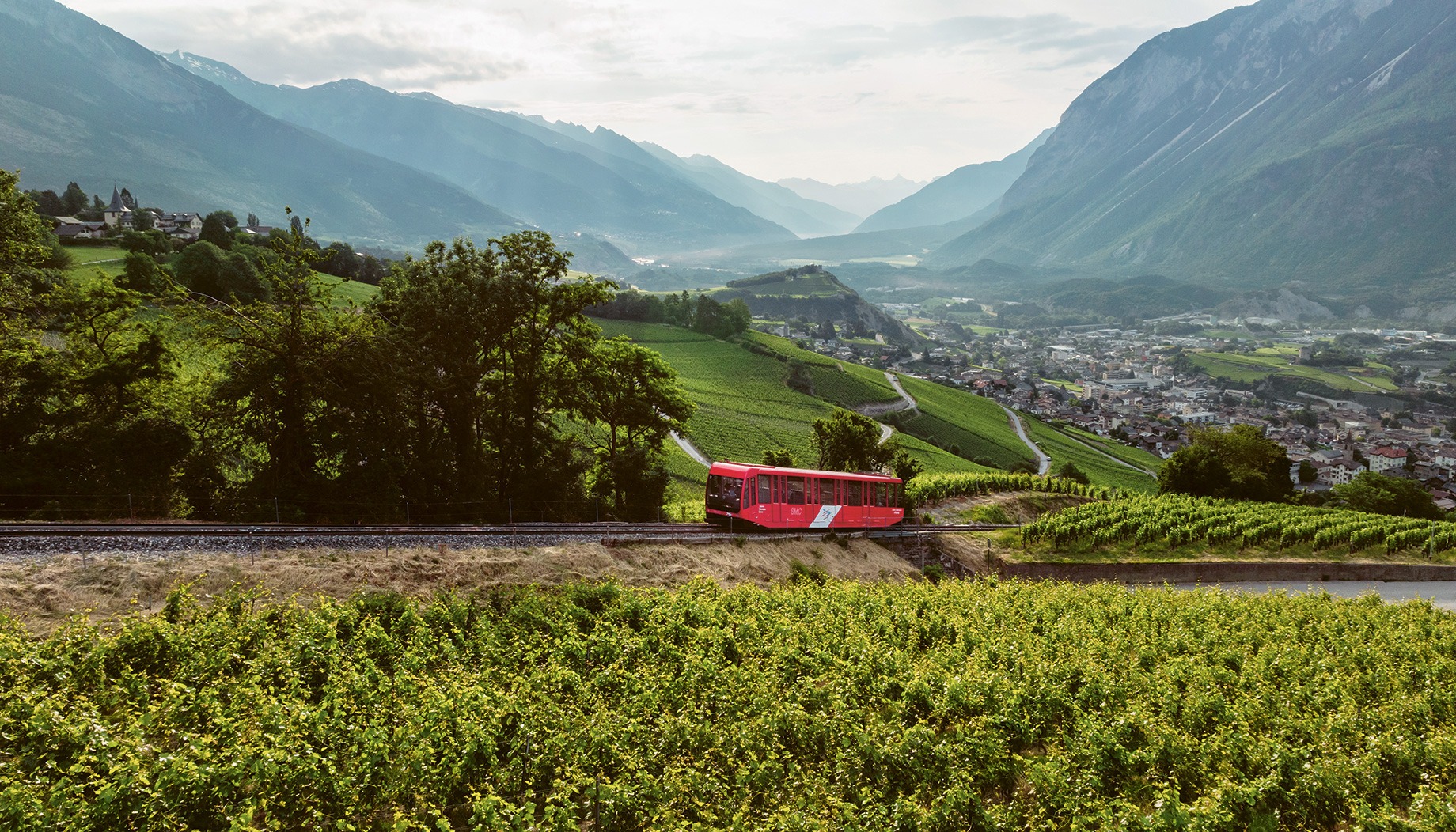
Just a few steps from Sierre train station, the Crans-Montana funicular provides easy access to the ski resort. It’s a beautiful scenic journey, which has delivered continuously — with a few stops along the way — for 115 years!
A mule ride from Corin, a sedan chair or a solid four-hour walk… At the end of the 19th century, the ways one could reach the High Plateau’s sanatoriums from the valley were as slow as they were limited, which presented a real problem for patients already in poor health. Around 1900, the promoters of the Hôtel du Parc laid a road (with a toll!) to the plateau, but automobiles back then were still rare and sluggish, barely reducing travel time. And so, three years later, a rack railway project emerged… only to be abandoned. In the end, the ideal mode of transport would be a funicular.
The issue was that it was impossible at that time to manufacture a cable long enough to pull the wagons across the 4,207 meters between Sierre and what would become Crans-Montana. Engineers adapted, adopting the idea of two successive sections, served by two different funiculars with an intermediate station where passengers changed vehicles. Ta da! Switzerland’s longest funicular was officially inaugurated on October 1, 1911.
While the first machines took nearly an hour to climb the 927 meters of elevation between the valley and the ski resort (at 5 km/h!), technological advances in 1929 halved the journey time — and then quartered it in 1997, when the two sections were merged into a single line. The most recent development, in 2022, saw a massive project replace the original rails, refurbish the stations, rebuild or add a total of four bridges and introduce new cars (in Valais’ colours). Now, the funi is an ideal mode of transportation for soaking in the panoramic views of Valais’ vineyards, forests and Alpine peaks that are gradually revealed along the gentle ascent. The cherry on top from a sustainability perspective? A new system for recovering braking energy was also installed, helping power part of the funicular’s next ascent, in addition to 155 solar panels at the upper station to fully ensure the installation’s CO2 neutrality. And just like that, the funicular entered the 21st century.